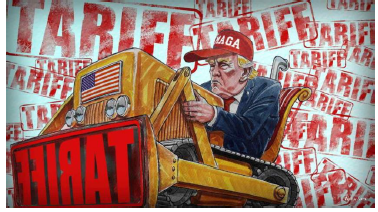
On January 14th, I participated in a Lawrence University Povolny Lecture Series Panel on how various aspects of U.S. foreign policy might change under the Trump administration. Panelists were asked to address the first two questions below; I added a third question. My sole focus was on trade policy.
1) Which policies will likely stay the same?
2) Which policies will likely change?
3) How might it matter?
My remarks follow:
Let’s start with how much trade currently exists, and a description of the trade authority available to the executive branch. In particular, given a 10 minute time limit, I’m restricting my discussion to trade with China, Canada, and Mexico. (Source: The Observatory of Economic Complexity)
| Trade with U.S. – 2023 | China | Canada | Mexico | % of U.S. Trade | Total U.S. Trade |
| Imports from | 11.6% | 12.5% | 13.7% | 37.8% | $3.857 Tr. |
| Exports to | 6.4% | 14.4% | 12.6% | 27.1% | $3.072 Tr. |
Three trade acts matter (See Congressional Research Services) in generating executive branch authority to impose tariffs.
1) Section 232 of the Trade Expansion Act of 1962 – President (w/o Congressional approval) can impose tariffs on imports that pose a threat to national security. President then must inform Congress in written form within 30 days of the decision.
2) Section 301 of the Trade Act of 1974 allows the President to take action to address unfair acts, policies, or practices of a foreign govt burdening US commerce. First action is to seek changes from the countries cited for such actions. WTO dispute resolution is possible, but in recent years, WTO’s powers have been both ignored and weakened.
3) International Emergency Economic Powers Act of 1977– gives the President the power to regulate international commerce and economic transactions during an emergency. It, however, requires consultation with and a report to Congress on its uses.
In answer to the first question, trade policy towards China has (and will continue to) followed similar perspectives. Both Biden and Trump administrations have used existent trade authority to limit China’s trade with the US and China’s global influence. Advocates cite both de-risking and de-coupling from China as the objective of such activities. Although in principle, the distinction between the two is significant, in practice this might be a distinction without a difference.
So, what has happened? Trump began the tariff war with China in 2018, and Biden has expanded both the stringency and the breadth of such tariffs. Trump threatens to be both more comprehensive in application and more stringent with potentially a 60% across the board tariff on imports from China. Biden has raised tariffs on imports from China to 50% on semi-conductors and solar panels and to 100% on electric vehicles.
China’s responses have been clear: match or exceed US tariffs with a focus on policies that hurt American agricultural and high tech interests. Furthermore, China has expanded trade with much of the rest of the world and emphasized that China’s exports come without lectures on human rights. As Keyn Jin argued in a recent Project Syndicate article, Trump’s tariffs will become China’s opportunities.
So what might Xi do in response to T’s proposed tariffs: we already know some of the actions China has taken in the past: impose roughly equivalent tariffs, let the renminbi depreciate vs. the dollar, place export restrictions on critical minerals (such as some rare earths), route products through other countries or perhaps negotiate, but the latter will be based on both knowledge of previous negotiations with Trump and a China better connected to the rest of the world.
One big difference relates to how the Biden and Trump adminstrations view trade with Mexico and Canada. Though he seemed proud of the USMCA trade deal completed and implemented in 2020, Trump now wants to impose a 25% tariff on both countries unless they stop the flow of both fentanyl and immigrants. Causality, including the role of US exports of guns to Mexican cartels, seems much more complex than T admits.
Here’s a brief background on trade with Canada and Mexico.
Top Canadian Exports to the US are: crude petroleum, petroleum gas, cars, refined petroleum, motor vehicle parts and accessories – total exports of $482 B in 2023.
Top Canadian Imports from the US are: cars, refined petroleum, motor vehicle parts and accessories – total imports of $441 B in 2023.
Top Mexican Exports to the US: computers, cars, and motor vehicle parts and accessories – total exports of $529 B in 2023.
Top Mexican Imports from the US: refined petroleum, motor vehicle parts and accessories, and petroleum gas – total imports of $367 B in 2023.
Both Biden and Trump have employed tariffs and quota restrictions on Canadian lumber and some agricultural products.
According to Joshua Meltzer of the Brookings Institution, trade among the three countries affects over 17 million jobs of which over 4.5 million jobs are in the U.S. Roughly 50% of U.S. trade with Mexico and Canada relates to supply chains for automobiles, medical equipment, energy, and agricultural products. No surprises here since the same items appear in both import and export lists for all three countries. For example, the production of automobiles often involves eight or more border crossings. Additionally, petroleum-related products flow through fixed infrastructure that can’t be easily replaced, hence the battle over projects such as the Enbridge Line 5 pipeline planned for northern Wisconsin.
Furthermore, tariffs are not uniformly applied across all products and producers. Section 301 (1974 Trade Act) allows the U.S. Trade Representative (USTR) to provide exemptions without oversight. Between 2018 and 2020, there were 7,015 applications to the USTR for exemption (Journal of Financial and Quantitative Analysis) of which 14.5% (1,022) were approved. Increased lobbying to (funding of) Republicans improved the prospects for exemption while such lobbying to Democrats reduced the prospects for exemption.
In contrast, the tariffs imposed on aluminum and steel imported from a variety of countries (under section 232 of the 1962 Trade Act) did face oversight from the Inspector General and showed no particular bias related to lobbying efforts.
According to a recent Tax Foundation report that summarizes a variety of tariff studies:
• Recent tariffs have been estimated to generate $79B in revenue.
• GDP, the stock of capital, and full time equivalent jobs have declined modestly.
• Average household income decline has been estimated to be between $200 and $700.
• Proposed new tariffs are envisioned to have much greater effects. Estimates range from $1,800 (Tax Policy Center) to $7,500 in reduced income per household (Yale).
• After accounting for retaliatory effects, there has been little to no change in trade balances across countries.
It’s also worth noting that after 25 years of negotiations, the European Union (EU) and Mercosur (a South American trade association) have just agreed (December 9th) to a trade deal that removes tariffs on cars, machinery, and consumer products, especially those related to supply chains; however, individual EU countries have not yet approved this deal.
The bottom line is that no trade policy is free:
• Trade is not a zero-sum affair with one country losing and another winning.
• Every policy comes with a price, actually three prices:
o Direct cost of implementing protectionist policy
o Cost imposed by other countries in retaliation
o Costs that arise when other countries follow the leaders, the US in particular, in selectively adhering to agreed upon trade rules (e.g, WTO and USMCA).
We don’t yet know the actual objectives for Trump’s tariffs. Possibilities include to:
• Complement industrial policy that seeks to increase manufacturing output – e.g. semiconductors
• Buy time for domestic producers to establish themselves – e.g., electric vehicles and solar panels
• Reduce dependency on a strategically important good – e.g., semiconductors, personal protective equipment, artificial intelligence
• Negotiate strategies with specific countries to either get them to reduce imports or accept more exports or give up territory. – e.g. more LNG exports, sell Greenland
• Replace the income tax with tariffs (This is Commerce Secretary designate Howard Lutnick’s preference)
Only time will tell which, if any, of these aims will predominate. Whatever the objective, in my view, we can expect reduced production, income, and employment overall both in the US and abroad as well as higher prices for some goods and services.
Furthermore, as Don Boudreaux recently put it, “tariffs reward a competitive advantage in political lobbying, not economic production, with the result that ‘tariffs shift capital and labor from more- to less-productive uses, inflicting widespread domestic economic damage.’”
 No Con Economics