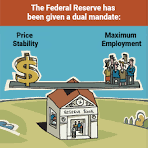
In 1977, Congress amended the Federal Reserve Act to instruct the Federal Reserve to employ monetary policy to achieve a dual mandate: maximum employment with price stability. This has frequently been interpreted as a directive to keep the unemployment rate (U-3) at roughly 4% and inflation (core CPI) at roughly 2%.
This balancing act has become increasingly difficult to achieve. As argued below, reductions in interest rates will increasingly lead to more substitution of capital and artificial intelligence for labor; thus, I do not recommend expansionary monetary policy as a strategy to expand the level of employment.
Most of the discussion of monetary policy has not addressed the potential mix of employment and capital as a result of changes in interest rates. The elasticity of substitution of capital for labor when the price of capital changes relative to the price of labor can be used to measure the effects of changes in interest rates on the mix of capital and labor. When interest rates decline, the price of capital falls relative to the price of labor. In a similar fashion, when the cost of health insurance rises, the price of labor rises relative to the price of capital; thus, one would expect capital to substitute for labor.
When an economy experiences a persistent supply shock, such as a rising price of energy, the result tends to be both higher inflation and higher unemployment. Monetary policy can’t be used to bring both indicators down to acceptable levels. Other public policy prescriptions would be needed to counter the supply shock.
The rise of artificial intelligence exacerbates the dual mandate problem for the Federal Reserve. If interest rates fall and the substitution of AI for labor can take place more quickly and at a lower cost than for plant and machines, then knowledge of the elasticity of substitution between capital and labor becomes particularly important.
To address this effect, I queried Gemini on the following question:
What empirical information is available on the elasticity of substitution of capital for labor when interest rates fall?
Here’s a summary of the response:
- Macroeconomic Consensus: the elasticity of substitution lies between 0.4 and 0.7. Since capital and labor often grow together in an expanding economy, and, despite the fact that interest rates reduce the cost of capital, firms don’t make large substitutions of machines for labor.
- Counter argument: One major study found an estimate of 1.25 based on the notion that declining real interest rates as well as in the price of capital goods in recent years, showed both aggressive purchase of capital and a decline in labor’s share of income.
- The largest elasticity and automation effects have taken place in the agricultural sector (elasticity greater than 1), noticeable substitution in manufacturing (elasticity around 1) and lesser responsiveness in service industries (elasticity well below 1)
- Since firms do not immediately respond to the changes in relative prices, long run substitution of capital for labor (elasticity greater than 1) is much higher than any short run effects.
- Historically, changes in interest rates affect the amount of labor employed through two channels: Aggregate Demand (in which labor and capital grow or fall somewhat together) and Factor Substitution (in which the relative price of capital in comparison with the price of labor drives the substitution of one for the other.)
- One interesting case relates to skill-based technological change in which lower interest rates tend to encourage (subsidize?) high-tech capital, such as that connected with AI.
Clearly, there is more to the story than the points just made. Measurement and production modeling choices affect the results. Nevertheless, the elasticity of substitution should be an important factor that affects monetary policy decision-making. An elasticity of 1 implies that a 10% decline in the cost of capital relative to labor will be associated with a 10% decline in the quantity of labor employed. Since labor’s share of income has fallen in recent years and since the adoption of AI can be done more rapidly than the replacement of labor with machines, the elasticity of substitution is probably greater than one for anything but the short run (that is, less than a year.)
Consequently, in my view, expansionary monetary policy should not be used in attempts to expand employment or to reduce unemployment.

